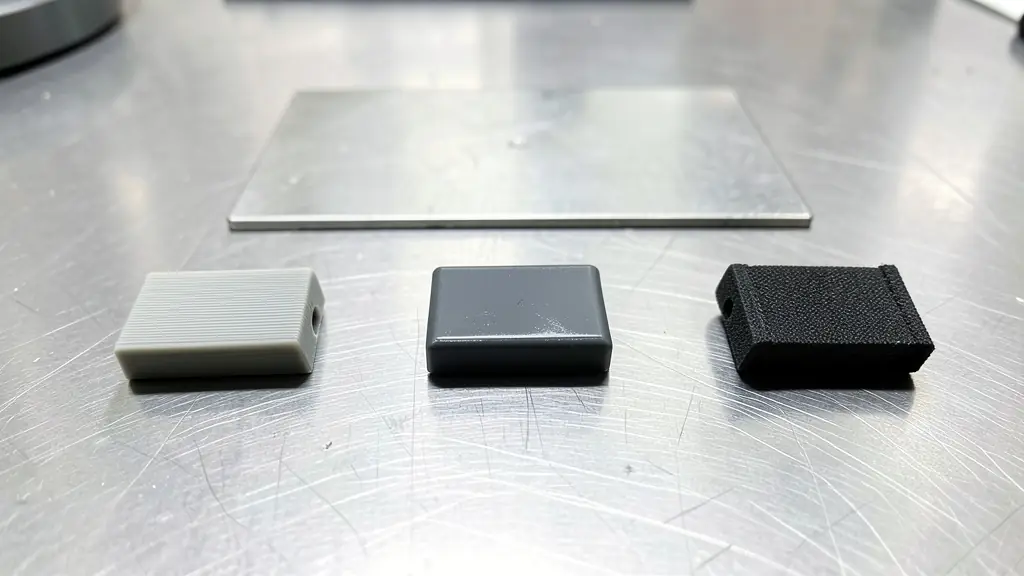
People often ask a shop for "a 3D print" and leave the process to chance, then get a brittle resin clip or a figure with layer lines across its face. The process should follow from what the part must survive and show. Tick the things that matter and this picker ranks FDM, resin and SLS nylon, with a line on why and the largest part each usually prints. Read the plastics behind each one on 3D printing materials.
How the ranking works
Each process has a score from 1 to 5 for seven things: detail, strength, heat, size, price, smooth surface and moving parts. The tool adds the scores for what you tick and lists the highest first.
The scores are our judgement, drawn from published comparisons by printer makers and bureaus and from the figures elsewhere on this site, such as heat ratings and shop prices. They are not a lab rating, so a close result means either will do and the shop's advice decides.
The three processes in one line each
- FDM: the cheapest per gram and the biggest parts, from about 220 to 350 mm on most shop printers. Layer lines show, and parts are weaker across the layers.
- Resin: the finest detail and a smooth skin for figures, jewellery patterns and dental models. Standard resin is brittle and the size is small.
- SLS nylon: tough parts with no supports, so hinges and chains print assembled. The skin is slightly grainy and the price follows the build space.
When the answer is not the whole story
- Heat: FDM scores well only in ASA, PC or nylon. PLA softens in a parked car.
- Strength: tough resins narrow the gap with FDM, at a higher price.
- Size: any process can print a bigger part in pieces and glue it.
- Price: SLS gets cheaper per part when many parts share one build.
- Safety: for a part that carries a load where failure could hurt someone, an engineer decides, not this tool.
Sources
- Resin printer maker E, FDM against SLA against SLS: SLA the finest detail and smoothest finish, isotropic; FDM visible layer lines, weaker across layers, needs supports; SLS slightly grainy, mostly isotropic, strength close to moulded parts, no supports; desktop build up to 300 x 300 x 600 mm FDM, 353 x 196 x 350 mm SLA, 165 x 165 x 300 mm benchtop SLS
- Online manufacturing network, selecting the right 3D printing process: accuracy: FDM ±0.5% (lower limit ±0.5 mm), SLA ±0.5% (±0.10 mm), SLS ±0.3% (±0.3 mm); layers FDM 50 to 400 μm, SLA 25 to 100, SLS 80 to 120; SLA thermosets stiff but more brittle than thermoplastics; supports: SLA always, FDM not always, SLS never; SLS and MJF suit higher volumes
- Online manufacturing network, how to design parts for SLS printing: wall 0.8 mm (PA12) to 2.0 mm (carbon filled); holes over 1.5 mm; escape holes at least 3.5 mm; minimum feature 0.8 mm, pins included; embossing and engraving 1 mm; tolerance ±0.3 mm plus ±0.05 mm per extra 25 mm; 0.3 mm bearing surface clearance for axles, 0.2 mm in an integrated hinge; build size about 300 x 300 x 300 mm on average, larger machines 700 x 380 x 580 mm
- Resin printer maker E, minimum wall thickness for 3D printing: minimum wall: SLA 0.2 mm, FDM 1 mm (1.2 mm works better on a 0.4 mm nozzle), SLS 0.6 mm vertical and 0.3 mm horizontal; vertical wire: SLA 0.2, FDM 3, SLS 0.8 mm; embossed detail: SLA 0.1 mm, FDM 0.6 mm wide and 2 mm high, SLS 0.1 to 0.4 mm; engraved: SLA 0.15 mm, FDM 0.6 mm wide and 2 mm deep, SLS 0.1 to 0.35 mm
- Industrial print bureau, PA12 (MJF) material page: density of parts 1.01 g/cm³ (ASTM D792); heat deflection 175 °C at 0.45 MPa; maximum part 370 x 274 x 375 mm; minimum wall 1 mm
- Printer maker B, enclosed core XY printer spec: build volume 256 x 256 x 256 mm (the maker's open frame model is the same size)
- Large format printer maker, 600 mm printer page: print volume 600 x 600 x 660 mm
- Printer maker C, MSLA printer product page: print volume 127 x 80 x 150 mm; about 100 W (±5 W) while printing
- Resin printer maker I, large MSLA printer product page: printing volume 223 x 126 x 235 mm; system power maximum 240 W
- Filament maker A, ASA technical data sheet: density 1.13 g/cm³; nozzle 230 to 260 °C; build plate 75 to 95 °C; drying 70 °C for 7 h; heat deflection 100 °C at 1.8 MPa, 103 °C at 0.45 MPa
- Filament maker A, polycarbonate technical data sheet: density 1.19 g/cm³; nozzle 250 to 270 °C; build plate 90 to 105 °C; drying 75 °C for 6 h; heat deflection 107 °C at 1.8 MPa, 111 °C at 0.45 MPa; enclosure recommended, heated chamber for large parts
- Filament maker B, high temperature nylon carbon fibre technical data sheet: density 1.06 g/cm³; nozzle 260 to 290 °C; bed 80 to 100 °C; drying 80 °C for 8 to 12 h; heat deflection 170 °C at 1.8 MPa, 194 °C at 0.45 MPa
- Board game and print maker, print and make price list: VAT n/s: FDM R1 a gram plus R20 set up; resin (SLA) R2 a gram plus R50 set up
- Johannesburg (Kya Sands) reverse engineering and print bureau, service rates: VAT n/s: 3D printing from R1.90 a gram, minimum R250; 3D scanning from R650 an hour, minimum R1,250, on site in Gauteng; scan to CAD from R650 an hour, minimum R1,500
- Cape Town (Parklands North) resin print service: VAT n/s: resin R12.50 a cm³ (1 ml) plus R50 an hour of print time; worked example 11 cm³ and 5 hours R387.50
Frequently asked questions
Which process is strongest?
Which process gives the most detail?
Why does SLS cost more for one small part?
Do I have to choose the process before I ask for a quote?
More calculators and tools
- Part weight calculatorGrams of plastic and a rough shop price from the size, material and infill
- Buy or outsource calculatorPaying a shop each month against owning a printer, and the break even month
- Scale model calculatorReal size to model size and back, and the smallest detail that will print
- Lithophane plannerPanel size, thickness, grams of white PLA and a rough print time
- Print farm capacity calculatorHow many good parts a number of printers make a day and a week
- Fit and clearance guideGaps for press, snug and sliding fits, and what size to draw a hole or a peg