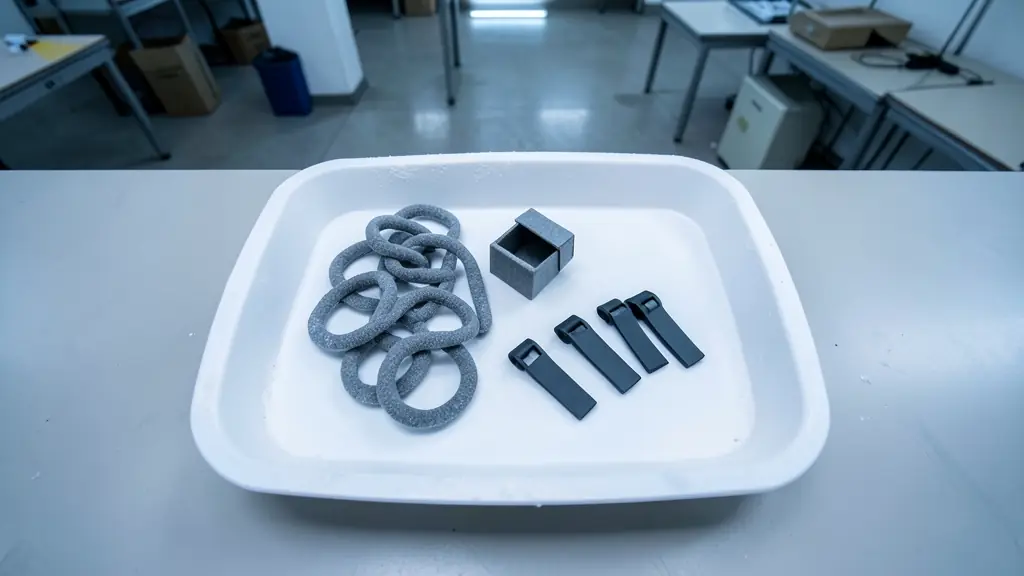
Picture a hinge, a chain or a gear set that comes out of the printer already put together and moving. That is the party trick of powder bed nylon. In SLS a laser, and in MJF an agent and heat, fuse fine PA12 powder layer by layer, while the loose powder around the part holds it up. No supports means freedom of shape, and nylon means parts that bend before they break. Most of this work is done by bureaus with large industrial machines.
Why designers pick powder nylon
- Moving parts, hinges and interlocking shapes print assembled, provided the drawing leaves a small clearance between them. Check the fit and clearance guide.
- Strength is close to even in every direction, unlike filament layers.
- PA12 is tough, a little flexible, and shrugs off oil and many chemicals.
- Dozens of small parts can share one build, which suits batch production.
What the surface looks like
Out of the machine, SLS parts are a slightly grainy, matte white to grey, like fine sandpaper or an eggshell. MJF parts are usually a darker grey. Neither shows layer lines much, and there are no support marks anywhere.
Most bureaus can dye parts black or a colour, which hides scuffs. Vapour smoothing seals the skin into a smoother, satin finish that is easier to clean and handles better, at an added cost.
How a bureau prices it
The quote leans on two things: the volume of nylon in your part and the box it takes up in the build. A long, thin frame costs more than its weight suggests, because it blocks space other parts could use. Hollowing and wall thickness of about 0.8 to 1 mm and up help.
Build schedules set the lead time. A bureau fills a build with many customers' parts, then runs, cools and unpacks it, which takes a day or more. Ask when the next build closes. If you miss it, a rush build of your parts alone is sometimes possible, but you pay for the empty space around them.
When FDM will do instead
- One large simple bracket: FDM in PETG or nylon filament is usually cheaper.
- A display piece that must look smooth: resin or finished FDM.
- Fifty small complex clips that must match: powder nylon wins.
- A living hinge or snap fit that flexes thousands of times: powder nylon again.
What to put in your request
- Attach STEP or STL and state the quantity
- Mention moving parts and the gaps drawn
- Choose raw grey, dyed black or smoothed
- Ask when the bureau's next build closes
- Say if parts can be split to save box space
SLS Nylon Printing: who orders it and why
- Makers and hobbyists: drone frames, hinged boxes and moving gadgets that print as one piece
- Schools, colleges and makerspaces: university engineering projects needing strong small parts from a bureau
- Engineers and product designers: snap fits, hinges and end use parts tested in real nylon
- Small businesses and sellers: short runs of clips, housings and product parts without a mould
- Factories, mines and workshops: change parts, guides and wear parts for bottling and packing lines
- Dental labs and clinics: orthotic and workshop parts made to the practitioner's own design and say
- Car owners and panel shops: ducts, clips and brackets for motorsport and restorations
- Architects, artists and prop makers: lightweight lattice sculptures and wearable pieces