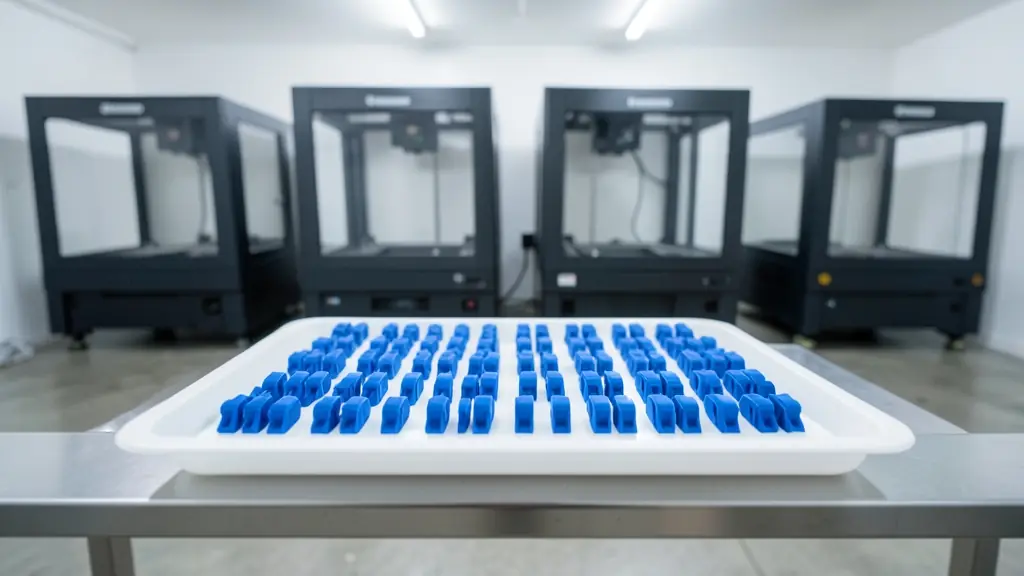
Five hundred branded keyrings for an expo or a thousand enclosures for a start up both come down to one question: how many good parts can the printers make a day? A plate that takes four hours does not give six plates a day, because printers wait for someone to clear them, need a spool change and now and then fail. This calculator counts those losses and gives good parts a day and a week, and how many days your order takes. More on batch production.
The defaults, all ours
- 20 printing hours a day: four hours go to clearing plates, maintenance and the odd jam.
- 80% of printers busy: some wait for an operator, a fresh spool or a repair at any time.
- 10 minutes a changeover: remove the plate, check the parts, start the next one.
- 7% failed: the same failure share the part weight calculator uses.
No one publishes these for a print farm, so change them to what you see in your own room.
A worked example
Five printers, a 4 hour plate with six parts each. Five printers at 20 hours and 80% busy give 80 printing hours a day. Each plate needs 4 hours and 10 minutes, so about 19 plates, or 115 parts.
Take off 7% for failures and about 107 good parts come off the shelf each day. An order of 1,000 parts then takes about nine and a half working days, before packing and the courier. Run the same order on ten printers and it halves, which is why promotional runs often go to larger farms.
Using the result in a plan
- Print one plate and time it, rather than trusting the slicer's estimate.
- Count the parts that actually fit on a plate with gaps between them.
- Run the calculator and add a day for checking and packing.
- For a deadline, ask the shop how many printers it can give your job, not how many it owns.
- Approve one sample before the full batch starts.
Frequently asked questions
Why not count 24 hours a day?
Is 7% failures realistic?
When is injection moulding cheaper?
Can several print farms quote on one big order?
More calculators and tools
- Part weight calculatorGrams of plastic and a rough shop price from the size, material and infill
- Buy or outsource calculatorPaying a shop each month against owning a printer, and the break even month
- Scale model calculatorReal size to model size and back, and the smallest detail that will print
- Lithophane plannerPanel size, thickness, grams of white PLA and a rough print time
- Technology pickerTick what the part must do: FDM, resin or SLS nylon, ranked with reasons
- Fit and clearance guideGaps for press, snug and sliding fits, and what size to draw a hole or a peg