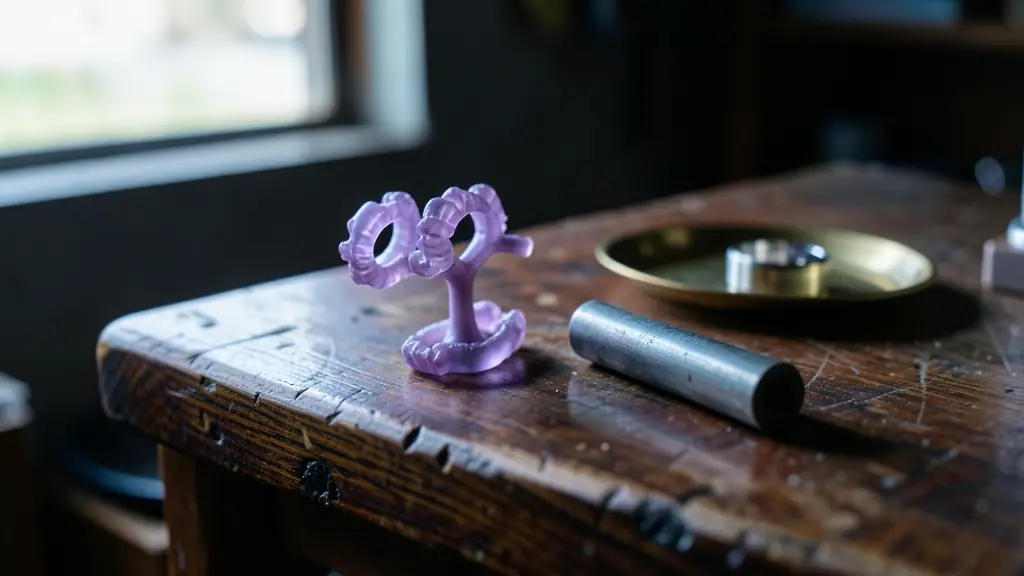
A Durban CBD jeweller who once carved every engagement ring in wax now sends a file instead, and gets back a resin pattern so fine that the claws and the milgrain are already there. The pattern goes to a caster, is invested in plaster, burnt out and replaced by silver, gold or brass. Printing does the carving; the metal work stays with the jeweller. A few labs also print finished pieces directly in resin or nylon for fashion jewellery.
From file to metal, step by step
- You or a CAD designer model the piece at the finished ring size.
- A resin bureau prints it in castable or wax like resin on a fine detail printer.
- The caster sprues the pattern, invests it in a flask and burns the resin out in a kiln.
- Molten metal fills the cavity; the plaster is broken away.
- The jeweller cleans, sets stones, polishes and sends it for hallmarking where it is wanted.
Read resin 3D printing for how the printers work.
Sizes a pattern must respect
As a rule of thumb, ring shanks under about 1.2 mm thick and claws thinner than about 0.6 mm risk not filling or bending in wear, but ask your caster, because alloys and setups differ. Metal shrinks a little as it cools, so many designers scale the pattern up slightly; the caster can tell you how much they allow.
Model at the finished inside diameter, and say which ring size system you used. A ring sized in one system and read in another can come back a full size out.
What the caster will ask for
- An STL or 3MF in millimetres, closed and watertight.
- The metal and karat, so they can weigh and price the cast.
- Where sprues can go without spoiling a polished face.
- Stone sizes and whether seats are cut in the file or by hand.
- How many: one bespoke ring, or ten in three sizes for a range.
If this, then that
- Fine claws and filigree: castable resin, printed at the finest layer the bureau offers.
- A chunky signet or a pendant to try on: a cheap standard resin proof first, then the castable print.
- Earrings that must be light and colourful: direct printed nylon, dyed, with no casting at all; see SLS nylon printing.
- Ten matching bridesmaid pendants: one master pattern, then a rubber mould and wax injections, often cheaper than ten prints.
What to put in your request
- The STL or 3MF, or a sketch with sizes
- Ring size and which sizing system you used
- The metal you plan to cast it in
- Whether you want a wearable proof first
- The date the finished piece is needed
Jewellery Printing: who orders it and why
- Makers and hobbyists: a one off ring or pendant designed at home, then cast by a local caster
- Schools, colleges and makerspaces: jewellery design students turning CAD projects into castable patterns for assessment
- Engineers and product designers: small precision patterns for cast metal parts, badges and fittings
- Small businesses and sellers: jewellers adding bespoke rings and short ranges without carving every wax by hand
- Factories, mines and workshops: investment casting patterns for small metal parts in short runs
- Dental labs and clinics: medical alert pendants and charms; nothing worn as a medical device
- Car owners and panel shops: cast badges and emblems for restorations, where the rights holder agrees
- Architects, artists and prop makers: artists casting small sculptures, charms and wearable pieces in bronze or silver