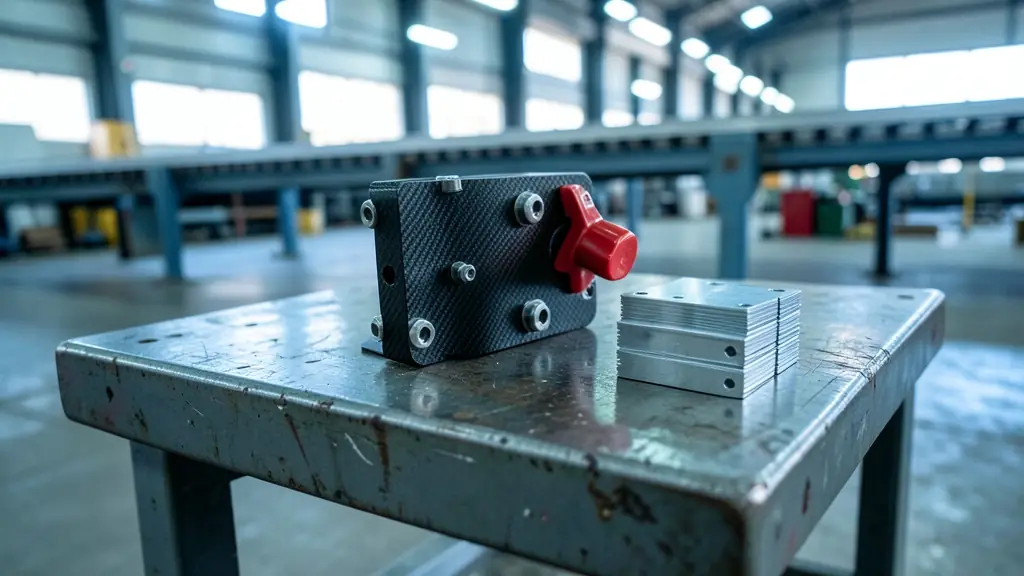
On a Paarl bottling line, a change part for a new bottle shape used to mean a drawing to a machine shop and a two week wait. Now the maintenance planner sends a STEP file on Monday and has a nylon star wheel segment by Friday. Printed jigs, fixtures and gauges are cheap enough to make for one job, quick enough to fix a line that is waiting, and easy to reprint when a shift wears one out.
What gets printed on a typical shop floor
- Drill guides and assembly jigs that hold parts in the same place every time.
- Go and no go gauges for checking a hole, a slot or a bottle neck.
- Soft jaws for a vice, shaped to the part, so it is not marked.
- Change parts, guides and pucks for packing and bottling lines.
- Cable and hose guides, sensor brackets and tool holders at each station.
Why print instead of machining one
Machining a fixture from a block means set up time, cutting away most of the material and a queue at the toolroom. Printing builds only the shape, with pockets and curves that cost nothing extra, so for one or two pieces it is usually quicker and cheaper.
Machining still wins for hardened wear faces, very tight tolerances over a long length, and parts near heat or solvents that plastics cannot take. Many jigs combine both: a printed body with pressed in steel bushings or threaded inserts.
Symptom and likely cause
- Jig flexes when clamped: walls too thin or infill too low; ask for more perimeters or carbon fibre nylon.
- Gauge reads tight on good parts: holes print slightly undersize; open them in the file or ream them.
- Locating face wears shiny: switch from PETG to nylon, or add a steel insert.
- Part warps near a heater or oven: PETG and PLA are wrong here; ask about higher heat materials.
The fit and clearance guide gives starting gaps.
Keep the file, reprint the wear
Store the final file and the print settings with the job number. When the jig wears, the shop reprints the same thing instead of measuring the worn one. For a few identical jigs across several lines, see batch production.
Anything that holds a load over people, lifts, or takes a crash load in a machine is decided by your engineer, never the print shop.
What to put in your request
- The STEP file, a drawing or the part itself
- What the jig holds and how it is clamped
- Critical dimensions and how you check them
- Heat, oil or cleaning chemicals it sees
- How many, and how often they wear out
Jigs and Fixtures: who orders it and why
- Makers and hobbyists: woodworking drill guides, router templates and holders for the home workshop
- Schools, colleges and makerspaces: TVET workshop jigs for learner projects and repeatable assembly practice
- Engineers and product designers: assembly jigs and check gauges for prototypes before tooling is cut
- Small businesses and sellers: packing station holders and small fixtures for a growing product line
- Factories, mines and workshops: line change parts, gauges, soft jaws and guides reprinted as they wear
- Dental labs and clinics: lab holders and fixtures for test equipment, not parts used on patients
- Car owners and panel shops: panel shop templates, trim fitting jigs and workshop tool holders
- Architects, artists and prop makers: repeatable cutting and glueing jigs for model makers and set builders