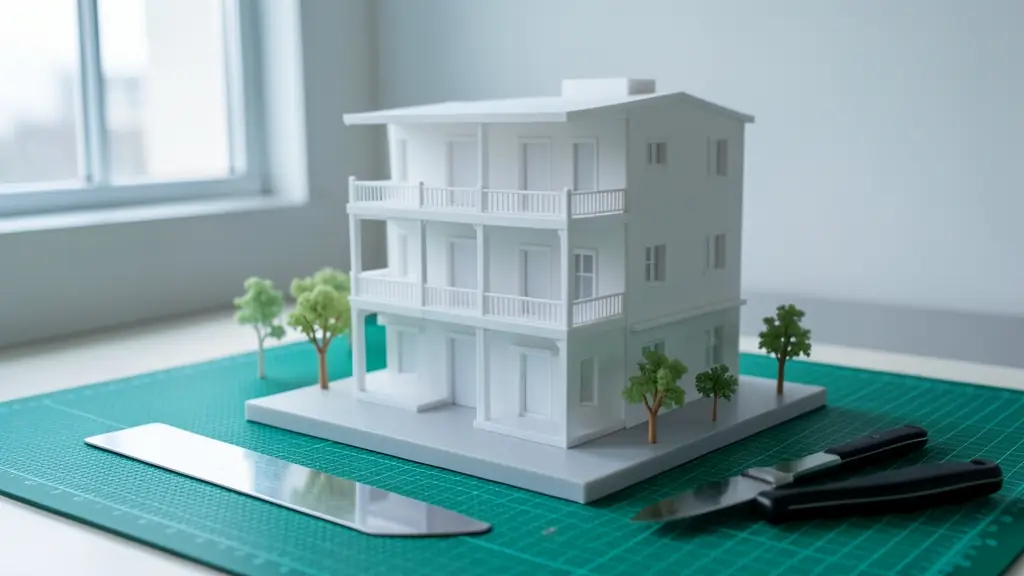
At 1:100 a 230 mm brick wall becomes 2.3 mm, which prints well. At 1:500 the same wall is under half a millimetre and an FDM printer simply leaves it out. This calculator converts between real and model sizes at the usual architectural, kit and miniature scales, then checks each size against the smallest wall and detail that bureau design guides say each process holds. Use it before a crit or a sales office deadline, and read more on architectural models.
The scales in the list
Architectural scales run from 1:20 for a stair or joinery detail to 1:1000 for a neighbourhood in blocks. Kit scales cover 1:10 busts, 1:24 cars, 1:35 military dioramas and 1:72 aircraft.
Miniature figures are named by height rather than ratio. We use one ratio each: 28 mm as 1:64, 32 mm as 1:54, 54 mm as 1:32 and 75 mm as 1:24, so a 1.8 m person comes out near 28 mm at the first. Makers vary a little, so check against a figure from the same range on miniatures and figurines.
The smallest real feature that prints
- FDM: walls of about 1 mm (1.2 mm on a 0.4 mm nozzle is safer) and raised detail about 0.6 mm wide. At 1:200 that means a real wall of at least 200 mm.
- Resin: standing walls of about 0.6 mm and detail down to about 0.2 mm, so window mullions and railings survive at 1:200.
- SLS nylon: walls and pins of about 0.8 mm, with holes over 1.5 mm or they fill with powder.
The tool multiplies each limit by the scale. Anything thinner in real life needs thickening in the model or leaving out.
Using it on a real model
- Pick the scale your brief or the sales office asks for.
- Type the thinnest real element you want to keep: a balustrade, a mullion, a canopy edge.
- Read which process can hold it. If none can, thicken it in the file before export.
- Check the whole model against the printer bed: a 60 m building at 1:200 is 300 mm long.
- Mention the scale and the thin parts when you send the file, so the shop prints a test piece first.
Sources
- Encyclopedia, miniature figure (gaming) scales: 28 mm about 1:64 to 1:62; 32 mm about 1:54 (now the most common figure size); 54 mm 1:35 to 1:32 (toy soldier, display figures); 75 mm 1:24 (largest common gaming scale)
- Encyclopedia, scale model: architectural models typically 1:12, 1:24, 1:48, 1:50, 1:100, 1:200, 1:500; 1:24 truck and car kits; 1:35 dominant for military vehicle kits; 1:72 the most numerous aircraft scale; 1:50 construction vehicles and house portraits
- Online manufacturing network, how to design parts for SLA printing: supported walls at least 0.4 mm, unsupported walls at least 0.6 mm; embossed detail at least 0.1 mm high, engraved 0.4 mm wide and deep; holes under 0.8 mm may close (table: minimum 0.5 mm); 0.5 mm clearance between moving parts, 0.2 mm for assembly connections, 0.1 mm for a push or snug fit; minimum feature 0.2 mm (castable resin); hollow walls at least 2 mm, drain holes at least 3.5 mm
- Online manufacturing network, how to design parts for SLS printing: wall 0.8 mm (PA12) to 2.0 mm (carbon filled); holes over 1.5 mm; escape holes at least 3.5 mm; minimum feature 0.8 mm, pins included; embossing and engraving 1 mm; tolerance ±0.3 mm plus ±0.05 mm per extra 25 mm; 0.3 mm bearing surface clearance for axles, 0.2 mm in an integrated hinge; build size about 300 x 300 x 300 mm on average, larger machines 700 x 380 x 580 mm
- Resin printer maker E, minimum wall thickness for 3D printing: minimum wall: SLA 0.2 mm, FDM 1 mm (1.2 mm works better on a 0.4 mm nozzle), SLS 0.6 mm vertical and 0.3 mm horizontal; vertical wire: SLA 0.2, FDM 3, SLS 0.8 mm; embossed detail: SLA 0.1 mm, FDM 0.6 mm wide and 2 mm high, SLS 0.1 to 0.4 mm; engraved: SLA 0.15 mm, FDM 0.6 mm wide and 2 mm deep, SLS 0.1 to 0.35 mm
- Resin printer maker E, benchtop SLS design guide: vertical walls 0.6 mm, horizontal 0.3 mm; pins 0.8 mm; holes 1.0 mm; clearance for separate parts 0.2 mm (features under 20 mm²) and 0.4 mm (over 20 mm²); printed together 0.3 and 0.6 mm; largest part in nylon 12 about 160 x 160 x 296 mm
Frequently asked questions
How do I work out a model size by hand?
Why does my thin wall vanish in the print?
Is a 28 mm figure really 1:64?
Who prints the model once I have the sizes?
More calculators and tools
- Part weight calculatorGrams of plastic and a rough shop price from the size, material and infill
- Buy or outsource calculatorPaying a shop each month against owning a printer, and the break even month
- Lithophane plannerPanel size, thickness, grams of white PLA and a rough print time
- Technology pickerTick what the part must do: FDM, resin or SLS nylon, ranked with reasons
- Print farm capacity calculatorHow many good parts a number of printers make a day and a week
- Fit and clearance guideGaps for press, snug and sliding fits, and what size to draw a hole or a peg