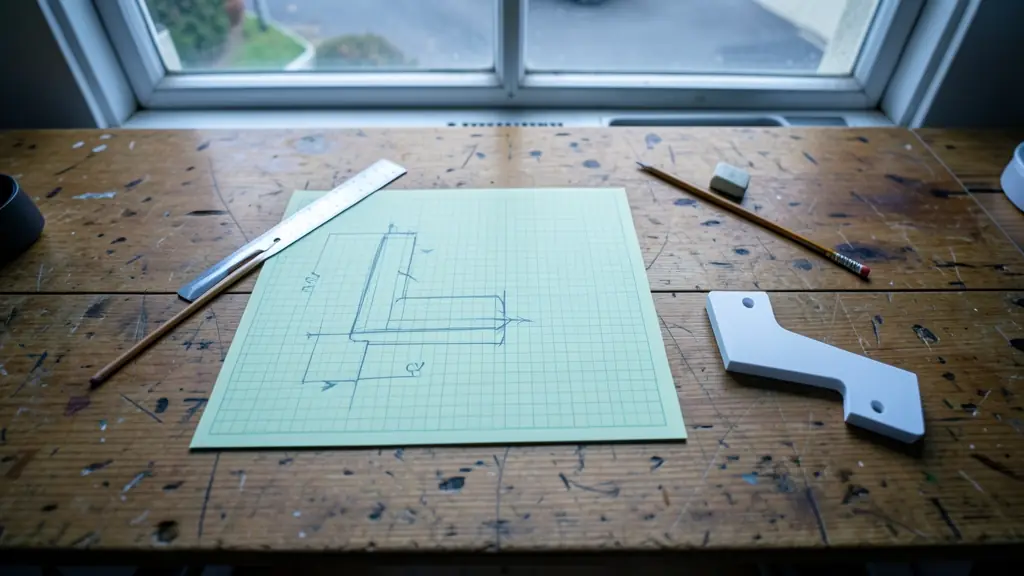
Most people who need something printed do not have a file. They have a broken latch, a phone photo of a gadget, a napkin sketch or just an idea for a holder that does not exist. A CAD designer turns that into a printable model, and the better you brief them, the fewer rounds of changes you pay for. Here is what to hand over, how design is usually quoted, and what to agree about owning the file before any work starts.
What you can start from
- A broken part: the designer measures it, or the pieces, and models it whole. See replacement parts.
- A sketch with sizes: the fastest start for brackets, boxes and holders.
- Photos: take them square on, with a ruler in shot, from several sides.
- An idea: describe what it does, where it goes and what it touches.
- A scan: useful for organic shapes such as a body part for a prop, but a raw scan always needs cleaning before it prints.
The brief a designer wants
- Overall sizes in mm, and which ones are fixed.
- What it fits onto or into, with that part's measurements.
- What it carries or resists: weight, heat, sun, flexing.
- How many you will print and with which process, if known.
- What it must look like, or whether only function matters.
For clips and lids, the fit and clearance guide explains the gaps a designer will build in.
How design is quoted
Expect design and printing to be priced separately. Design is usually by the hour or as a fixed fee for a defined part, with a set number of change rounds included. A simple bracket may take little time; a fitted enclosure with clips and screw bosses takes much more.
A sensible order: the design, a test print, one round of fixes, then the final print. Changing your mind after the test print is normal; changing the whole idea is a new quote.
Who owns the file
Agree it in writing. Some designers hand over full rights; others license the file to you for your own use and keep the right to reuse it. Ask for a STEP file as well as the STL so another designer can edit it later.
Copying a logo, a character or someone else's product does not become yours by redrawing it: ask the rights holder. If a person could be injured when the part breaks, an engineer approves the design, not the designer alone.
What to put in your request
- A sketch, photos with a ruler, or the part itself
- The sizes that must be exact, in mm
- What it fits onto and what it carries
- How many you will print and in what material
- Whether you want the STEP file handed over
Custom 3D Design: who orders it and why
- Makers and hobbyists: a holder, organiser or gadget mount designed from a sketch and a few measurements
- Schools, colleges and makerspaces: a learner's competition idea turned into a clean model for a print shop
- Engineers and product designers: a concept turned into an editable STEP model ready for a first prototype
- Small businesses and sellers: a product idea designed, test printed and refined before a short run
- Factories, mines and workshops: a worn machine part measured and modelled so spares can be printed on demand
- Dental labs and clinics: a model or aid designed to the lab's or clinician's own specification
- Car owners and panel shops: a discontinued clip or trim piece measured from the old one and remodelled
- Architects, artists and prop makers: a prop, sculpture or set piece modelled from reference pictures