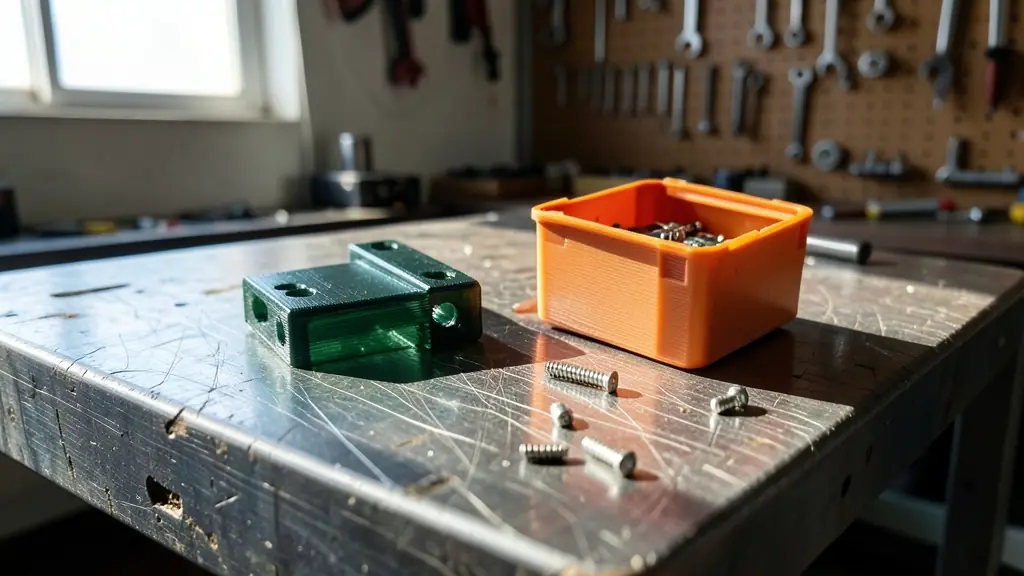
Most parts that leave a print shop in South Africa are FDM: a nozzle melts plastic filament and lays it down one thin line at a time, building the part from the bed upward. It is the workhorse for brackets, enclosures, jigs, clips and anything big, because it is quick to set up and cheap per gram. It will not give you the glassy skin of resin, but ordered well it gives you a tough, useful part.
What FDM does well, and what you will see
FDM suits functional parts, big parts and one-offs where price matters more than a perfect surface. Shops usually slice layers somewhere between a tenth and three tenths of a millimetre with a 0.4 mm nozzle, so the sides show fine ridges like the grain in wood.
Look closely and you will also find a seam where each layer starts, usually hidden on a back edge, and rough patches under overhangs where supports were snapped off. If those matter, say which face is on show, or ask about sanding and painting.
How the shop sets up your part
- Layer height: 0.12 to 0.16 mm for a display piece, around 0.2 mm for most parts, thicker for fast rough prints.
- Walls: more outer walls make a stronger skin and help a screw hold. Two or three is common; four or more for parts that are clamped.
- Infill: the honeycomb inside. Around 15 to 20% for a cover, 40% or more for a bracket. It drives the gram count, so check it in the part weight calculator.
Orientation decides strength
Layers bond to each other less well than plastic bonds along a line. A hook printed standing up can snap cleanly along a layer, while the same hook printed lying flat is far tougher. Tell the shop which way the load pulls and it can turn the part to suit, even if that costs a little more support. If a snapped part could injure somebody, an engineer signs it off, not the shop.
Three plastics, one line each
- PLA: stiff, crisp, easy, but it softens around 55 to 60 °C, so not for a car dashboard in a Polokwane summer.
- PETG: tougher and less brittle, takes more heat and sun; a good default for parts that work.
- ASA: made for outdoors and heat, for things on a gate or a bakkie roof; it needs an enclosed printer.
Need rubbery or wear resistant? Ask about TPU or nylon, or compare with SLS nylon.
What to put in your request
- Say what the part holds and which way the load pulls
- Mention heat, sun, water or oil it will meet
- Mark which face must look good
- Ask for the walls and infill to be listed
- Give the quantity and whether colour must match
FDM 3D Printing: who orders it and why
- Makers and hobbyists: organisers, mounts, toy repairs and garden fittings printed cheaply per gram
- Schools, colleges and makerspaces: robotics chassis, bridge models and design projects in PLA
- Engineers and product designers: functional prototypes and enclosures tested before tooling is paid for
- Small businesses and sellers: display stands, counter holders and product mock ups at low cost
- Factories, mines and workshops: guides, covers, chutes and holders for the line in PETG or nylon
- Dental labs and clinics: workshop aids, holders and positioning jigs signed off by the practice
- Car owners and panel shops: dash clips, vent parts and brackets in heat tolerant plastic
- Architects, artists and prop makers: large sculpture bodies, prop cores and model bases printed fast