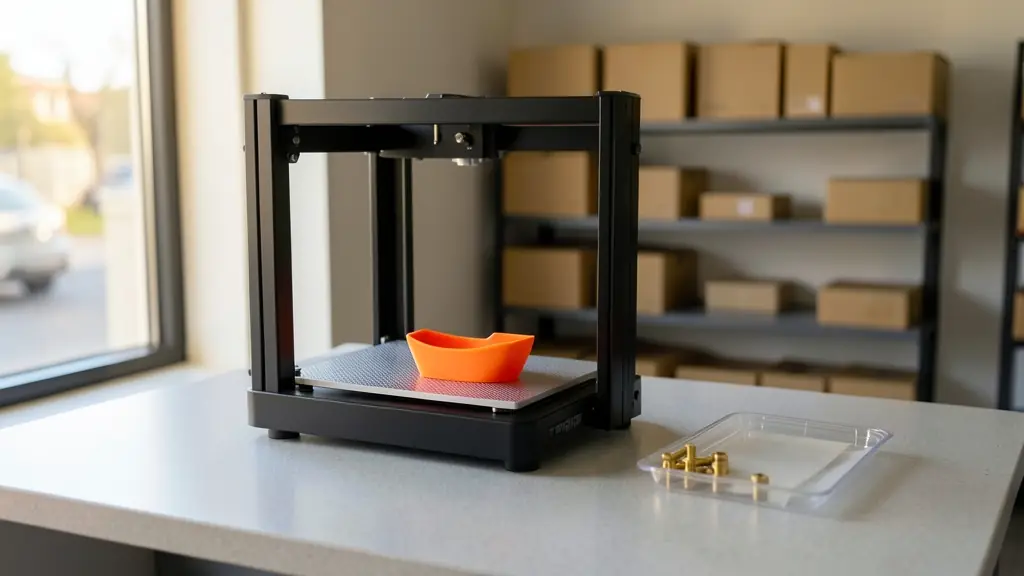
Plenty of people buy their first printer from an online listing, unpack it on the dining room table and spend a weekend fighting it. Walking into a shop costs a bit more time and sometimes a bit more money, and buys you something a listing cannot: a person who prints on that model every day, a warranty claim you can carry in, and spares on a shelf in town. Here is what a good 3D printer shop gives you and how to arrive knowing what to ask for.
What the shop adds to the box
- A demo print: ask to see the exact model running, and a part it printed.
- Setup: assembled, levelled and test printed before you take it home.
- A first lesson: loading filament, slicing a file, clearing a jam.
- Local warranty: who repairs it, where, and how long it takes.
- Spares in stock: nozzles, build sheets, a hot end, resin vats and screens for resin printers.
- Trade ins: some shops take your old machine against a new one.
Choosing in three questions
- What will you make? Brackets, organisers, cosplay pieces and school projects point one way; 28 mm figures and jewellery patterns another.
- FDM or resin? FDM melts filament and suits tough, larger parts. Resin gives fine detail on small parts but needs washing, curing and ventilation. Most homes and classrooms start with FDM.
- How big? Measure the largest part you expect, then add a margin. Bigger beds cost more and fill more desk.
If you only need a few parts a year, check the buy or outsource calculator first: paying a print shop may be cheaper.
If the shop says this, ask that
- "It is the same as the imported one." Then ask whether the local warranty still applies.
- "It comes ready to go." Ask whether they level and test it before handover.
- "Parts are easy to get." Ask which ones they keep on the shelf today.
- "It prints everything." Ask what it struggles with: ASA and nylon often need an enclosure.
Running costs nobody mentions
Filament or resin is the obvious one. Less obvious: nozzles and build sheets wear, resin screens and vat film are consumables, and a load shedding cut halfway through a twelve hour print wastes the plastic. A small UPS for the printer and a spare sheet are worth pricing in.
Ask the shop to quote the machine, a starter roll and a spares kit together so you compare like with like.
What to put in your request
- What you want to print, with an example part
- The biggest part size you expect, in mm
- FDM, resin, or not sure yet
- Your budget including filament and spares
- Whether you want setup and a first lesson
3D Printer Shop: who orders it and why
- Makers and hobbyists: a first desktop printer for figures, organisers and household fixes, set up before handover
- Schools, colleges and makerspaces: an enclosed classroom printer with a lesson for the teacher and spares on the shelf
- Engineers and product designers: a reliable machine for prototypes and fit checks with repairs handled close by
- Small businesses and sellers: a second or third printer for a small print service, bought with a spares kit
- Factories, mines and workshops: a workshop printer for jigs and spares that a local agent can service
- Dental labs and clinics: a resin printer for lab models chosen with the shop and the lab's own supplier advice
- Car owners and panel shops: a printer for clips, ducts and trim test pieces in a garage that gets hot
- Architects, artists and prop makers: a resin or FDM machine for props, sculptures and casting patterns, demoed first