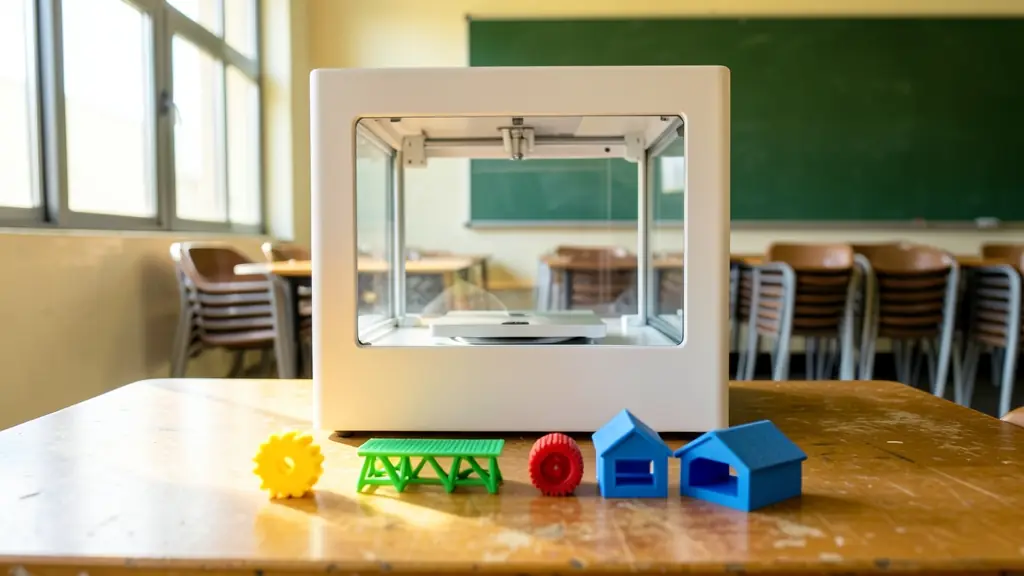
In most schools the printer arrives before the plan does. A sponsor donates one, it sits in the computer lab, a few enthusiasts print keychains and then the nozzle clogs in the second term. A teacher in Mthatha or a TVET lecturer in Polokwane can avoid that with three decisions made up front: a printer that suits a room full of learners, a clear link to what they are already teaching, and a budget for filament that does not run out in August.
A printer that belongs in a classroom
- Enclosed, so curious fingers stay off the hot nozzle and bed.
- Quiet enough to run during a lesson.
- Simple to level, ideally automatic, with a removable flexible build sheet.
- FDM with PLA: no fumes worth worrying about in a ventilated room, no liquid resin to spill.
- A local shop that keeps nozzles and sheets, so a fault is a week, not a term.
Leave resin printers for staff or a supervised senior lab: uncured resin needs gloves, ventilation and careful washing. See the printer shop page on buying with support.
Where it fits the curriculum
In broad terms, 3D printing supports Technology in the senior phase, Engineering Graphics and Design when learners model in CAD, robotics clubs that need brackets and wheels, and computer applications when designing on screen. Check your own syllabus and assessment guidelines, or ask your subject adviser; we do not speak for the department.
The useful habit is designing, printing, testing and fixing. A bridge that fails under load teaches more than one that works first time.
Running it through a year
- Train two teachers, not one, so the printer survives a transfer. Many shops and colleges run short courses.
- Set a filament budget per learner: small designs, a maximum print time and a gram limit.
- Keep a print log: whose file, how long, did it work.
- Start a club for learners who want more, with older members checking files.
- Send big or urgent projects, like a matric exhibit, to a print shop.
Problems teachers report
- Prints come loose halfway: a dirty or unlevel bed. Wipe it and relevel.
- A queue of forty files the week before marks: book printer slots per class early in the term.
- Huge, solid designs: teach infill and a size limit. The part weight calculator shows the grams.
- Downloaded models handed in as projects: require the learner's own CAD file.
What to put in your request
- How many learners and which grades or courses
- How many printers and whether enclosed
- Whether you need teacher training on site
- Your filament budget for the year
- Whether you want big projects printed for you
School 3D Printing: who orders it and why
- Makers and hobbyists: a weekend makerspace printer that members book by the hour
- Schools, colleges and makerspaces: an enclosed classroom printer, teacher training and a filament budget per learner
- Engineers and product designers: a university or TVET lab printing student prototypes and design project parts
- Small businesses and sellers: a training provider running short 3D printing courses for teachers and adults
- Factories, mines and workshops: an apprentice training centre printing jigs and models for practical lessons
- Dental labs and clinics: a nursing or health sciences college printing anatomy teaching models
- Car owners and panel shops: a motor mechanics workshop at a college printing cutaway models and clips
- Architects, artists and prop makers: an art or design school printing sculptures and scale models for portfolios