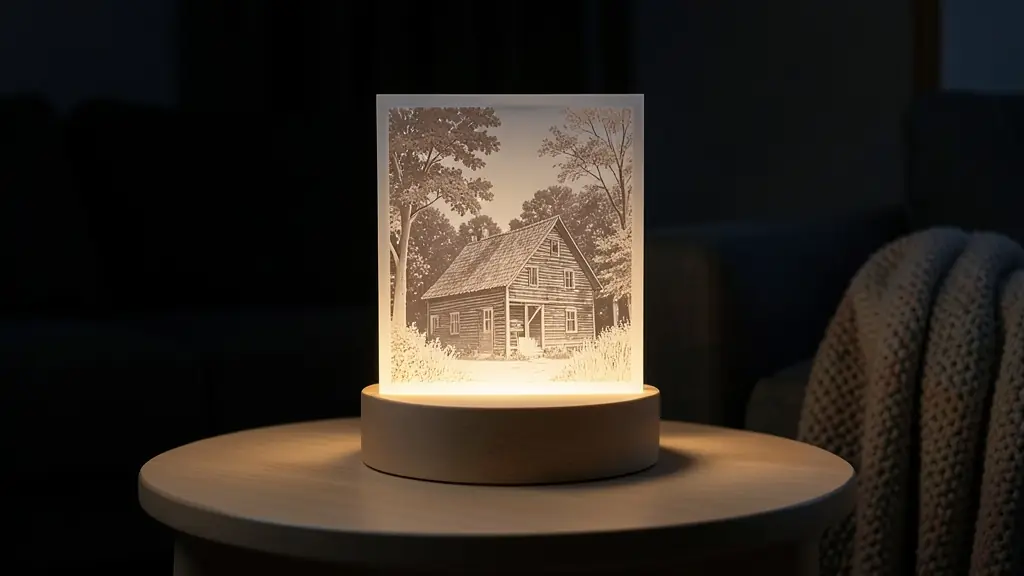
A lithophane looks like a plain white tile until a light goes on behind it. Thin spots let light through and read as the bright parts of the photo, thick spots stay dark. That means the panel's size and its thickest point decide most of the plastic and the hours. Pick a common photo size or a curved lamp panel, and the planner gives the grams of white PLA and a rough print time, so you know what you are asking a shop for. More on lithophane gifts and lamps.
The defaults and where they come from
- Thickness: 0.8 mm at the brightest point to 3.2 mm at the darkest, the range lithophane guides give for white PLA.
- Layers: 0.12 mm, printed standing up, so each fine step in the photo shows.
- Speed: about 30 mm/s, which works out to roughly 1.6 mm³/s of plastic, far slower than an everyday print.
- Border: 3 mm of solid frame around the picture. That is our default; set your own.
What the result means
A 10 x 15 cm panel with an average thickness near 2 mm holds about 30 cm³ of plastic, or roughly 40 g of PLA with its border. At lithophane speed that is around six to seven hours on the printer. A 20 x 25 cm panel more than triples both.
A curved lamp panel uses a little more plastic than a flat one of the same face size. A photo that is mostly dark sky or shadow sits nearer the thick end and weighs more. A shop will usually print a small test strip first for a batch of gifts.
Choosing a photo that works
- Pick a sharp photo with faces close up and good contrast; small faces in a crowd turn to mush.
- Crop it to the panel shape before you send it.
- Avoid big pure white areas: at 0.8 mm they look washed out.
- Decide on flat, curved or a lamp with a base, and the size, before asking for quotes.
- Allow extra time before Mother's Day and December, when shops are busiest.
Sources
- Lithophane generator site, slicer settings for lithophanes: layer height 0.12 mm, about 0.2 mm the coarsest; 30 mm/s for best results; print standing up; 99% infill; white or silver grey filament works best; example maximum thickness 3.2 mm
- Printer maker L blog, lithophane technical guide: a standard lithophane 0.8 to 3.2 mm thick; layer 0.1 or 0.12 mm printed vertically; 30 to 45 mm/s; 100% infill; natural or white PLA
- Encyclopedia, photo print sizes: 4 x 6 in 102 x 152 mm (10 x 15 cm 100 x 148); 5 x 7 in 13 x 18 cm 127 x 178 mm; 15 x 20 cm 148 x 200 mm (6 x 8 in 152 x 203); 8 x 10 in 20 x 25 cm 203 x 254 mm
- Printer maker C, creating profiles for different nozzles: layer height at most 70 to 80% of the nozzle; extrusion width about 110% of the nozzle, and 1.125 x the nozzle when the width is left at 0
- Filament maker B, PLA technical data sheet: density 1.24 g/cm³; nozzle 190 to 230 °C; bed 35 to 45 °C (smooth cool plate); drying 55 °C for 8 h; heat deflection 54 °C at 1.8 MPa, 57 °C at 0.45 MPa; Vicat 57 °C
- Filament maker A, PLA technical data sheet: density 1.17 g/cm³; nozzle 190 to 230 °C; build plate 25 to 60 °C; drying 55 °C for 6 h; heat deflection 58 °C at 1.8 MPa, 60 °C at 0.45 MPa; Vicat 63 °C
Frequently asked questions
Why white PLA and not a colour?
Why does a small panel take so long?
Can I change the thickness range?
How do I get a lithophane printed from my photo?
More calculators and tools
- Part weight calculatorGrams of plastic and a rough shop price from the size, material and infill
- Buy or outsource calculatorPaying a shop each month against owning a printer, and the break even month
- Scale model calculatorReal size to model size and back, and the smallest detail that will print
- Technology pickerTick what the part must do: FDM, resin or SLS nylon, ranked with reasons
- Print farm capacity calculatorHow many good parts a number of printers make a day and a week
- Fit and clearance guideGaps for press, snug and sliding fits, and what size to draw a hole or a peg