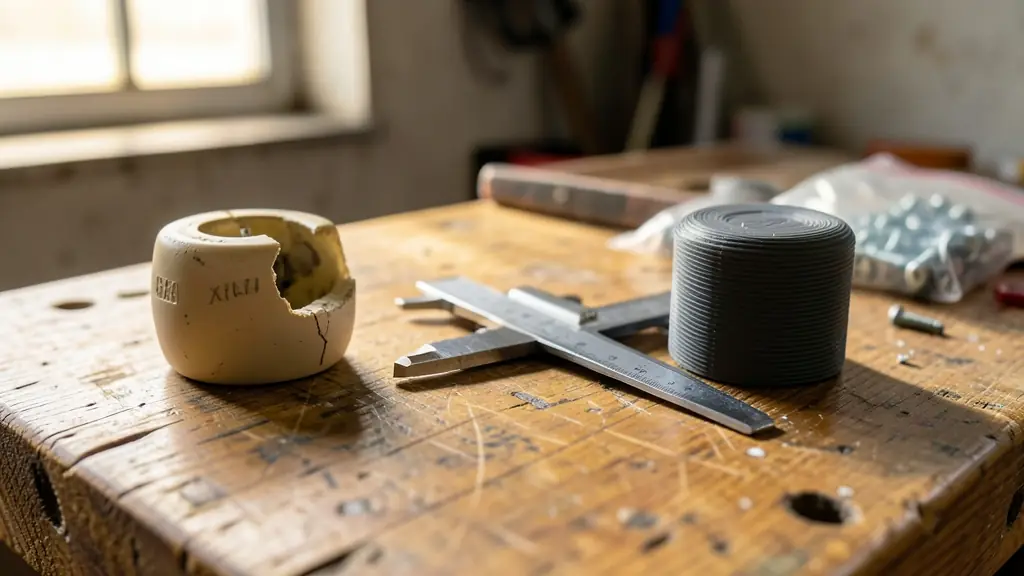
The till drawer handle in a Polokwane hardware store snapped, the till is fifteen years old and the maker stopped selling parts long ago. That is the everyday job for a print shop: one broken plastic piece, no spare anywhere, and a machine that works fine apart from it. Knobs, clips, brackets, caravan catches, blind cord ends, dishwasher wheels and machine covers can usually be remade, often in a stronger plastic than the original, as long as you bring the shop enough to measure.
What to bring to the counter
- The broken piece, every fragment of it, in a bag. Glued together is fine.
- The part it fits, or a photo of the socket, shaft or rail it clips onto, with a ruler in the picture.
- A few measurements taken with a calliper if you have one: shaft diameter, hole spacing, overall length.
- What it lives through: a hot oven door, a boat deck in the sun, oil on a lathe.
If nothing is left of the original, a drawing with sizes still works. A designer turns it into a file first; see custom 3D design.
Scan, drawing or straight measuring?
Most simple parts are measured by hand and drawn in CAD software in under an hour: a knob is a cylinder with a D shaped hole, a bracket is a plate with two holes. A 3D scan earns its cost on curved, organic shapes such as a car interior trim piece or a vintage radio dial, and even then the scan needs cleaning before it prints.
Ask whether the file is yours afterwards. Keep it, and the next time the clip breaks you send a file instead of a bag of bits.
Matching the plastic to the job
- Kitchen and indoor parts away from heat: PLA is often enough.
- Near a stove, in a parked car or in a caravan in Karoo summer: PETG or ASA, because PLA softens around 55 to 60 °C.
- On a boat, a gate or anything in full sun: ASA, which shrugs off UV.
- Clips that flex every day and gears that wear: nylon or carbon fibre nylon.
- Rubber feet and grommets: TPU.
Not sure? Use the technology picker or let the shop suggest it.
Print one, try it, then print the batch
- The shop prints a first piece, often in cheap PLA.
- You fit it: does the shaft go in, does the clip click, do the screws line up?
- Note what is tight or loose in millimetres, not "a bit".
- The file is adjusted and the final part printed in the right material.
Holes print slightly undersize on FDM, so a snug fit can take one round. The fit and clearance guide shows the usual gaps.
What to put in your request
- Photos of the broken piece with a ruler in shot
- What it fits onto and how it attaches
- Heat, sun, water or oil it must survive
- How many you need, now and later
- Whether you can drop off or courier the original
Replacement Parts: who orders it and why
- Makers and hobbyists: stove knobs, blind cord ends, drawer runners and toy parts nobody sells any more
- Schools, colleges and makerspaces: lab stool feet, projector mount clips and replacement parts for robotics kits
- Engineers and product designers: a one off housing or bracket to keep a test rig running until the real part arrives
- Small businesses and sellers: till covers, display hooks, coffee machine knobs and signage clips for the shop
- Factories, mines and workshops: guards, cable clips and covers for older machines whose maker has closed
- Dental labs and clinics: non contact aids such as wheelchair trim clips and equipment knobs the user approves
- Car owners and panel shops: interior trim clips, vent louvres and switch surrounds for older and classic cars
- Architects, artists and prop makers: broken parts for vintage cameras, radios and stage props remade to the original shape