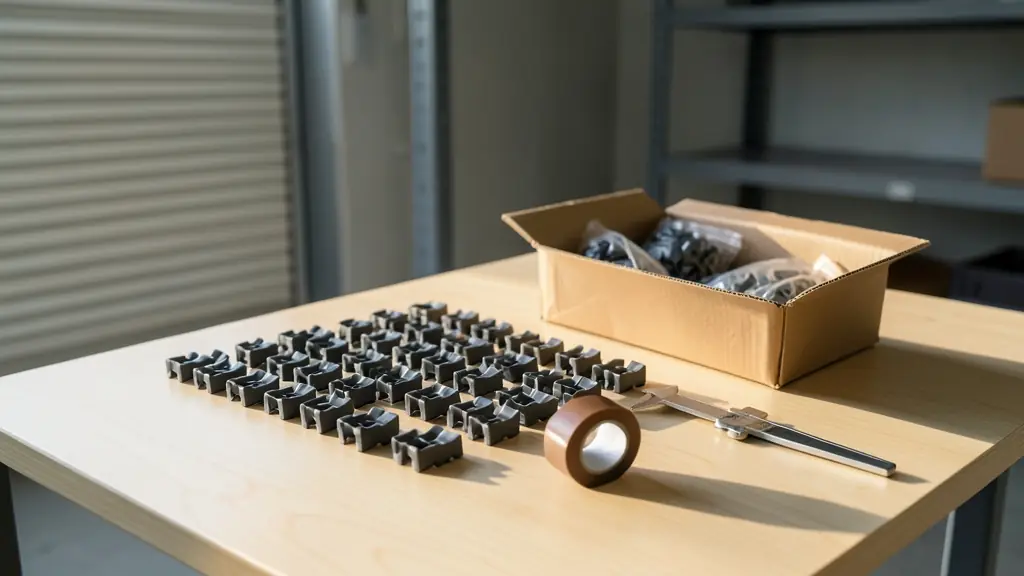
One good part is a print job. Two hundred good parts that all fit the same housing is a production run, and that is a different conversation with a shop. A start up in Woodstock moving from ten enclosures to a thousand, or a Paarl bottling plant after forty identical guides, needs the same three things: a process that suits the number, a sample everyone signs off, and a way to check that part 180 still matches part 1.
Three ways to make the same part many times
A print farm is a room of FDM printers running the same file side by side. It suits tens to a few hundred parts, any size up to a normal bed, in PLA, PETG or ASA. Ask the shop how many machines it can give your job; the print farm capacity calculator shows what a day of N printers turns out.
An SLS or MJF build nests dozens or hundreds of small nylon parts in one box of powder, so the whole batch comes out together with no supports. See SLS nylon printing.
Injection moulding needs a steel or aluminium tool first, which is costly and slow, but each part after that costs very little.
Where printing stops making sense
There is no fixed number. Printing wins while the tool cost of moulding is bigger than what you save per part, and while the design may still change. As a rough picture, printing is usually the answer for tens and low hundreds, and moulding starts to look better somewhere in the thousands for a small, simple part.
Part size moves the line (big parts eat printer hours), and so do repeat orders. If the design is settled and you need 5,000 a year, get a moulding quote too.
Keeping a batch consistent
- Colour drift: filament from two production lots can differ slightly. Ask the shop to run the whole order from one lot, or to split by box.
- Size creep: different printers in a farm can vary. Name the dimensions that matter and ask how often they are measured.
- Weak parts: often a temperature or cooling change midway. A fixed, saved print profile prevents most of it.
- Surface marks: the seam and support side. Agree where they may go.
From sample to repeat order
- Order one to five samples and test them in the real product.
- Sign off a sample in writing, with the critical sizes and the colour, and keep one.
- Agree how parts are checked, counted and packed: loose, bagged in tens, or labelled per carton.
- Split delivery if you need the first hundred before the rest.
- Ask the shop to keep the file, the material and the slicer profile on record so a repeat next year matches.
What to put in your request
- The quantity now and what you expect to reorder
- The file, ideally STEP as well as STL
- The sizes that must hold and how they are used
- Colour, finish and which face must look clean
- The deadline and whether a split delivery helps
Batch Production: who orders it and why
- Makers and hobbyists: a club order of matching tokens, stands or bases printed for every member
- Schools, colleges and makerspaces: a set of identical robot chassis parts for every team in the class
- Engineers and product designers: a pilot run of enclosures to test assembly before paying for a moulding tool
- Small businesses and sellers: a product line of cases, holders or gifts restocked from the same saved file
- Factories, mines and workshops: forty identical line guides or change parts made and labelled in one order
- Dental labs and clinics: matching storage trays and lab aids for several benches in the same order
- Car owners and panel shops: a small run of clips or trim pieces for a restorer's club or a panel shop
- Architects, artists and prop makers: an edition of identical sculptures or set pieces for a production run