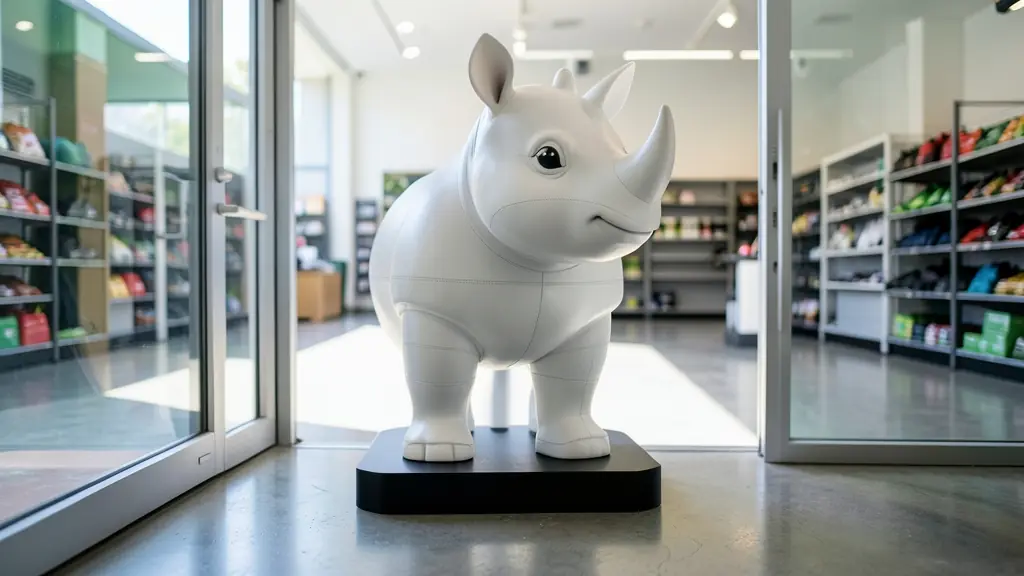
Most printers in a shop build in a box of about 250 to 350 mm. A rhino mascot for a shop entrance, a life size helmet, a 1 m reception logo or a display arch is far bigger than that. Shops print big things the same way furniture makers build cupboards: in pieces that lock together. Done well, the seams disappear under filler and paint, and nobody guesses how many parts went into it.
How a model gets split
The shop cuts the model in CAD or the slicer along lines that are easy to hide: an edge, a panel line, a change in colour. Each piece is sized to fit the bed and to print with little support.
Where pieces meet, it adds keys and pins: a peg on one face and a socket on the other, or holes for a dowel or steel rod. That lines the parts up and carries load across the joint. Tell the shop where the object is lifted or leant on, so the cuts avoid those spots.
If you are worried about this, ask that
- Visible seams? Ask for filler, sanding and primer at the joints. See post processing.
- Too heavy to move? Ask for a hollow shell with few walls and light infill.
- Takes too long? Ask whether a bigger nozzle, 0.6 or 0.8 mm, suits the parts that are not detailed.
- Will it fall over? Ask for a weighted base or a steel rod down the middle.
- Standing outside? Ask about ASA or PETG instead of PLA, and a UV stable paint.
How long a big part runs
Print time grows fast with size. A 600 mm figure split into eight or ten pieces can easily need several days of machine time, plus a day or more to glue, fill and paint. Shops with large bed printers or a print farm can run the pieces side by side.
Before you ask, check the size against common beds with the part weight calculator and the technology picker, and give your real deadline, not a hopeful one.
Getting it home or to the venue
- Decide whether it travels joined or in sections you assemble on site.
- Ask for foam or bubble wrap between pieces and a rigid box per section.
- For a bakkie trip, lay it down and strap the box, not the print.
- For courier, ask for the box size first; very large boxes cost more.
What to put in your request
- Give the finished height, width and depth in mm
- Say indoors or outdoors, and where it stands
- Mark faces that must show no seam
- Choose raw, primed or fully painted
- Say how it travels and the latest date
Large 3D Prints: who orders it and why
- Makers and hobbyists: full size helmets, statues and garden pieces printed in sections
- Schools, colleges and makerspaces: large exhibition models and open day displays split across printers
- Engineers and product designers: full scale mock ups of housings and panels for fit and look
- Small businesses and sellers: shop mascots, window displays and reception logos
- Factories, mines and workshops: large guards, covers and models of plant parts for planning
- Dental labs and clinics: large anatomy models for teaching, printed to the institution's own brief
- Car owners and panel shops: body kit mock ups, bumper sections and large ducts for shaping
- Architects, artists and prop makers: theatre sets, film props and gallery sculptures over a metre tall